

Published · Updated · By Jeff Brick, 2026 SDMLS President
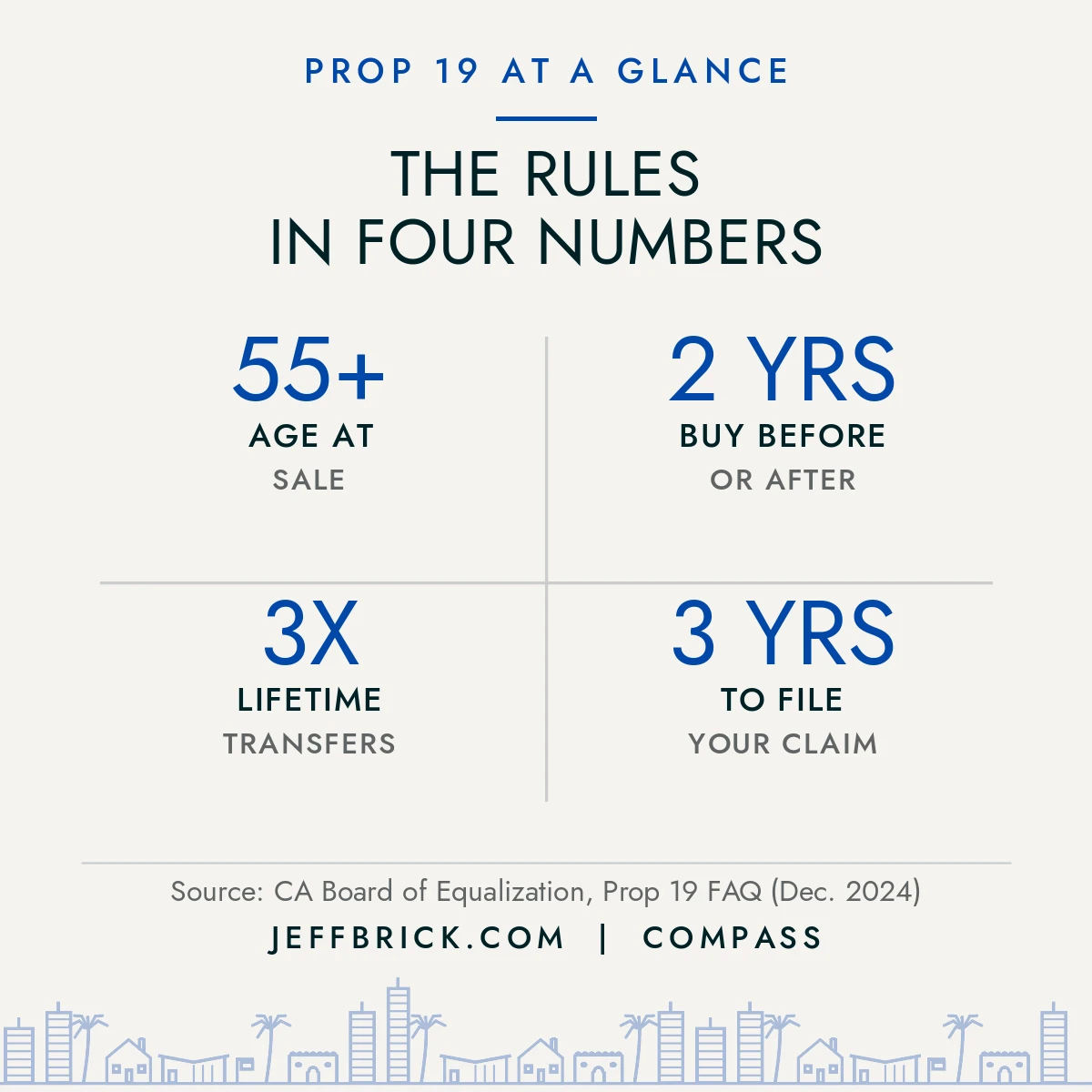
Quick answer: Prop 19 lets California homeowners who are 55 or older, severely disabled, or whose home was hit by a wildfire or natural disaster carry their lower property tax base to a replacement home anywhere in California. You must buy or build the new home within two years before or after selling the old one, the new home generally needs to cost no more than 100% to 110% of the old home’s sale value (more on that below), and owners 55+ can do it up to three times. You file the claim with the County Assessor where the new home sits, within three years of buying it.
This is general information, not legal, tax or financial advice. Every situation is different, so confirm your eligibility and numbers with the San Diego County Assessor and your tax professional before you sell.
Why Prop 19 matters so much to San Diego sellers
I meet longtime San Diego homeowners every month who would love to move. Maybe it is a family home in Clairemont with too many stairs, and the dream is a single-level home in Rancho Bernardo or a lock-and-leave condo in Little Italy. The thing that stops them is rarely the price of the next home. It is the fear of trading a property tax bill based on a purchase from decades ago for one based on today’s prices.
That is exactly the problem Prop 19 was written to solve. Voters approved it in 2020, and the base year value transfer part took effect on April 1, 2021. It is written into Revenue and Taxation Code section 69.6, and the California State Board of Equalization (BOE) publishes the official guidance that county assessors follow.
Who qualifies for a Prop 19 base year value transfer
According to the BOE’s Prop 19 FAQ for assessors (LTA 2024/044), three groups can transfer a base year value:
- Homeowners 55 or older. You must be at least 55 on the date the original home sells. If you are married, only one spouse needs to be 55.
- Severely and permanently disabled homeowners, at any age, with a physician’s certification. The San Diego County Assessor uses form BOE-19-D plus a certificate of disability.
- Victims of a wildfire or a Governor-declared natural disaster, at any age, when the home was substantially damaged or destroyed (more than 50% of its land or improvement value, per the BOE).
Both homes must be your principal residence. The home you sell must have been eligible for the homeowners’ or disabled veterans’ exemption, and a vacation home does not qualify. Property owned by a legal entity does not qualify either.
The rules, step by step
1. The two-year window
You must buy or build the replacement home within two years before or after selling the original home. The BOE notes there is no hardship extension to that two-year period, so put the dates on your calendar on day one. Renting for a while between homes is fine, as long as the purchase lands inside the window.
2. Anywhere in California, up to three times
Under the old rules, San Diego County only accepted transfers from a short list of counties. Prop 19 opened it to the whole state. The San Diego County Assessor says it plainly: you can move to any county in the state, and an individual may qualify three times. The BOE adds that a married couple can potentially use the transfer six times, and disaster transfers do not count toward the three-time limit.
3. The “equal or lesser value” test
This is where the strategy lives. Your replacement home is compared to the market value of the home you sold, and the allowed limit depends on timing, per BOE Publication 800-3:
- Bought before you sell: up to 100% of the original home’s sale value.
- Bought within the first year after the sale: up to 105%.
- Bought within the second year after the sale: up to 110%.
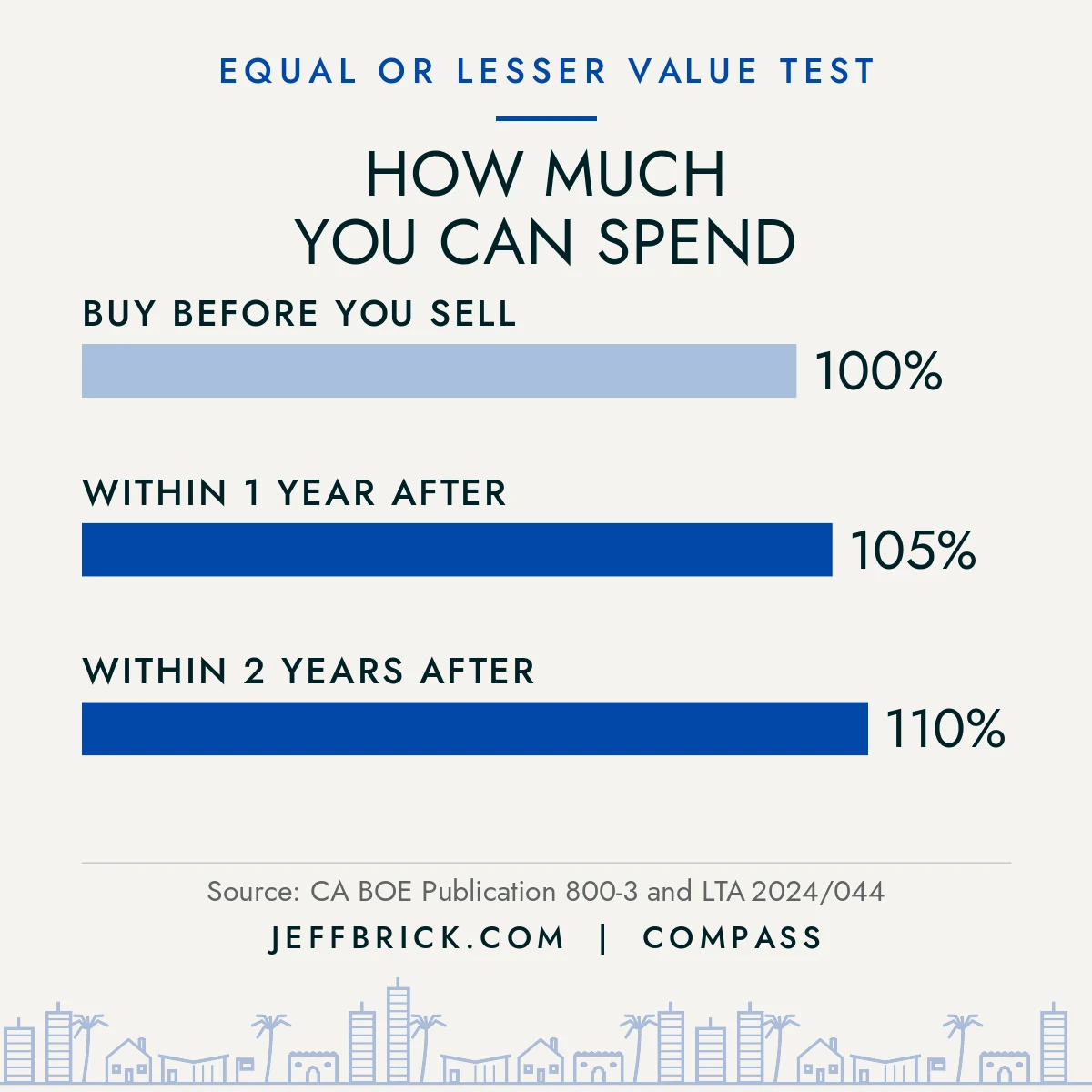
Here is the big change from the old rules: you can now buy a more expensive home and still keep most of your tax break. Any amount above the limit is simply added on top of your transferred base value.
A real example from the BOE
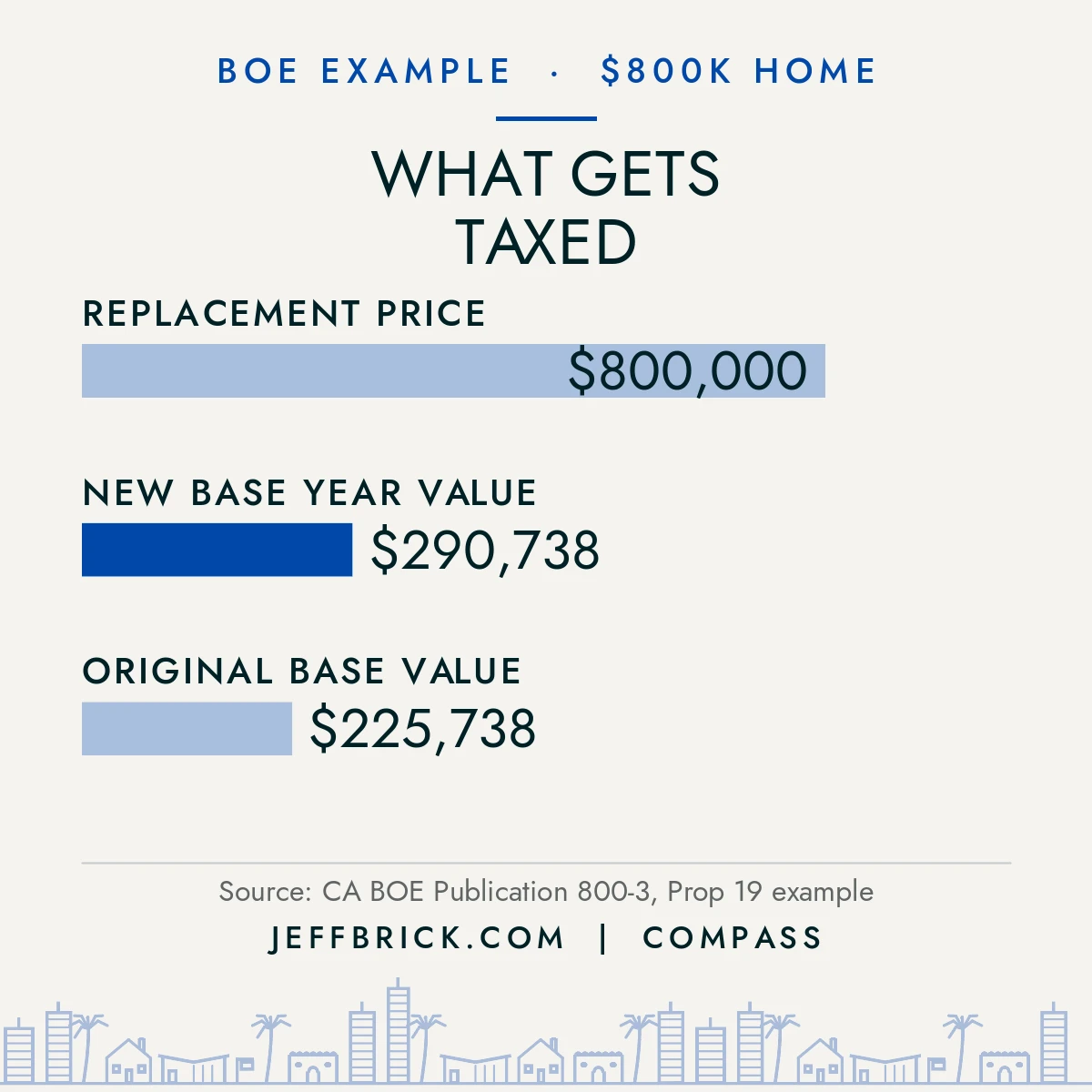
In the BOE’s own Publication 800-3 example, an owner sells a home worth $700,000 that carries a factored base year value of $225,738, then buys a replacement within the first year. The 105% limit is $735,000. If the replacement costs $800,000, the extra $65,000 is added, and the new home’s base year value becomes $290,738. In other words, the owner is taxed on a value of about $291,000 on an $800,000 home, not the full purchase price.
4. File the claim on time
Owners 55+ file form BOE-19-B with the Assessor in the county where the new home is located. The San Diego County Assessor’s Senior/Disabled Exclusion page says you must apply within three years of buying your replacement home. File late and the BOE says relief starts only from the year you file, with no refund for earlier years. Remember to file the homeowners’ exemption on the new home too.
How to time a sell-and-buy move in San Diego
Because the limit grows from 100% to 110% over two years, the order of your sale and purchase changes your budget. Buying first gives you certainty about where you will land, but your limit is 100% of the sale value. Selling first lets you know your exact number and gives you up to 110% of room, but you need a place to live in between. I walk through bridge loans, contingent offers and rent-backs in my guide to buying and selling at the same time in San Diego.
Your sale price also sets your Prop 19 limit, so pricing and preparation matter twice. Start with an honest number (here is how agents really price a San Diego home), then focus on the repairs that actually pay off. When you need movers, inspectors or a lender for the next purchase, my Approved Vendors directory is a good place to start.
A quick note on inherited homes
Prop 19 also narrowed the parent-to-child exclusion, effective February 16, 2021. Today the child must apply for the homeowners’ exemption within one year, and the exclusion is capped. For transfers from February 16, 2025, through February 15, 2027, the BOE set that cap at $1,044,586 above the factored base value. If you are planning an estate, talk with an estate attorney before you sell or transfer anything. And if you own a designated historic home, my Mills Act guide covers a different way to lower your tax bill.
Jeff’s take
Prop 19 is the most underused tool I see among San Diego homeowners over 55. Many people still believe the old rule that the next home had to cost less, or that they could only move to a handful of counties. Neither is true anymore. The smartest moves I help with start with three questions: what will the current home sell for, which month will we close, and what does that make the 100%, 105% and 110% limits? Once we know those numbers, the right next home usually becomes obvious.
As a Compass REALTOR®, 2026 President of the San Diego Multiple Listing Service, a 2024 to 2026 Director of the San Diego Association of REALTORS®, and a Southern California luxury apartment home leasing broker, I see this play out from every angle: owners who sell, buy, rent in between, or right-size into a high-rise. My motto is “Million Dollar Service at All Price Points,” and a well-timed Prop 19 move is one of the most valuable things I can deliver.
Thinking about selling and moving? Let’s map it out
Call or text me at 858-324-4448 and I will build you a free sell-and-buy plan with your estimated sale price, your Prop 19 limits by month, and a short list of homes that fit. You can also read how I would sell your home or browse all of my San Diego neighborhood guides to find your next spot.
Prop 19 California FAQ
Can I use Prop 19 to move from San Diego to another California county?
Yes. Since April 1, 2021, a base year value transfer works anywhere in California. You file with the Assessor in the county where the new home is located.
Can I buy a more expensive home and still use Prop 19?
Yes. If the new home costs more than 100%, 105% or 110% of your old home’s sale value (depending on timing), the difference is added to your transferred base value. You keep most of the benefit instead of losing all of it.
Do both spouses need to be 55 or older?
No. According to the BOE, only one spouse needs to be at least 55 on the date the original home sells.
How many times can I transfer my tax base?
Owners who qualify by age or disability can transfer up to three times. Transfers after a wildfire or natural disaster do not count toward that limit.
What is the deadline to file a Prop 19 claim in San Diego County?
File within three years of buying or finishing your replacement home. The San Diego County Assessor’s Senior/Disabled Exclusion Unit handles these claims at (619) 531-5481.