

Published · By Jeff Brick, 2026 SDMLS President
Quick answer: In the City of San Diego, every short-term rental (any stay of less than one month) needs two things before the first guest arrives: a free Transient Occupancy Tax (TOT) certificate and a Short-Term Residential Occupancy (STRO) license in one of four tiers. Tiers 1 and 2 are unlimited. Tier 3 (whole-home rentals outside Mission Beach) is capped at 1% of the city’s housing units, with 807 licenses still available as of October 23, 2026. Tier 4 (Mission Beach) is full, with 0 remaining and a waitlist. Guests then pay a TOT of 11.75% to 13.75%, depending on where the home sits.
I get this question from investors almost every week: “Can I Airbnb it?” In San Diego, the honest answer is “maybe, and here is exactly what it takes.” Below are the short-term rental rules in plain English, built from the City’s own pages so you can run your numbers before you write an offer.
The four STR license tiers in San Diego
The City’s STRO ordinance took effect on May 1, 2023, and the City Treasurer’s STRO page (updated October 23, 2026) sorts every host into one of four tiers:
- Tier 1, Part-Time: the home is rented for 20 days or less per year in total. The host does not have to live there. Unlimited licenses.
- Tier 2, Home Sharing: you rent a room or rooms for more than 20 days a year while you live onsite. You may rent the whole home while you are away for up to 90 days per calendar year. Unlimited licenses.
- Tier 3, Whole Home: you rent for more than 20 days a year and do not live onsite, anywhere in the city outside Mission Beach. Capped at 1% of the city’s housing units outside Mission Beach.
- Tier 4, Mission Beach Whole Home: the same as Tier 3, but inside the Mission Beach Community Planning Area. Capped at 30% of Mission Beach’s housing units.
One detail surprises people: the City says renting 21 to 89 days a year is “not allowed under the STRO Ordinance.” Tier 3 and Tier 4 hosts must rent at least 90 days a year during the license term, so a whole-home license is meant for a real rental business, not a few weekends.
How many licenses are left?
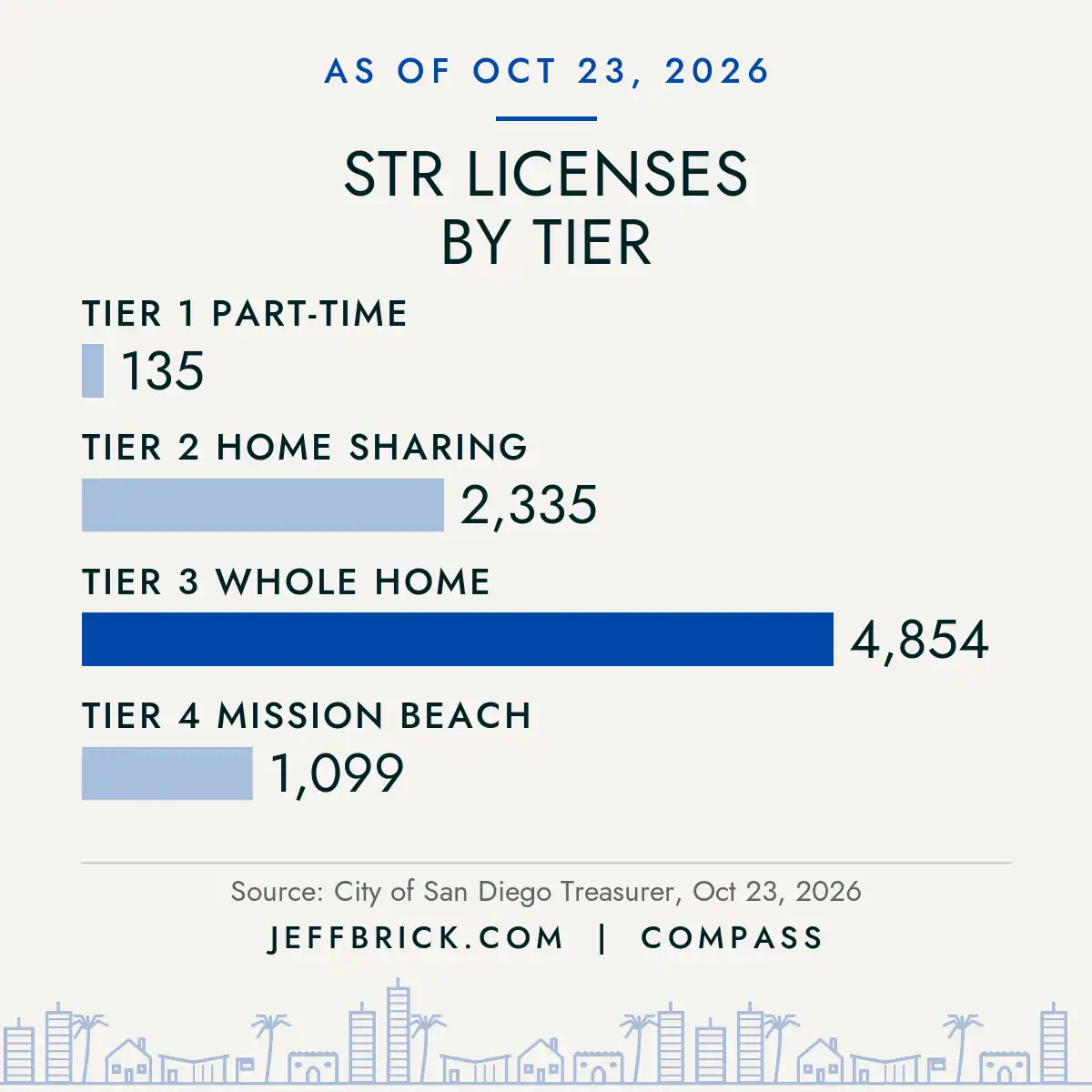
As of October 23, 2026, the City counted 8,423 licenses in total: 135 in Tier 1, 2,335 in Tier 2, 4,854 in Tier 3 and 1,099 in Tier 4. That leaves 807 Tier 3 licenses and 0 Tier 4 licenses.
Mission Beach is waitlist-only. The Tier 4 application window closed on August 15, 2025, after a random lottery set waitlist positions, and the City posts the current Tier 4 waitlist on its site. If your plan depends on a Mission Beach whole-home rental, assume you cannot get a new license soon.
What an STR license costs
The fees below have applied since March 1, 2025, per the City’s fee table. Each license lasts two years, renewals cost the same, and all fees are non-refundable.
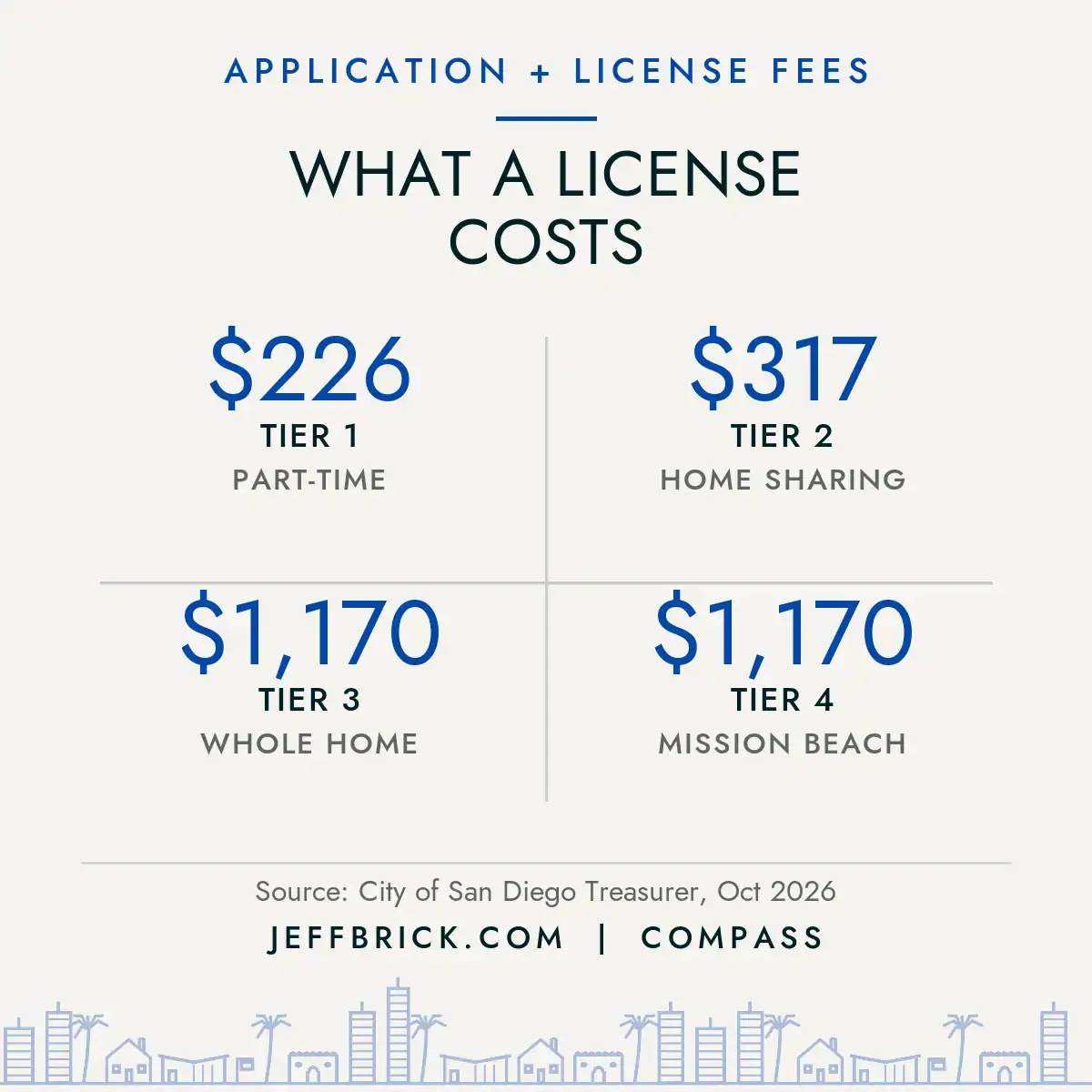
- Tier 1: $33 application + $193 license = $226
- Tier 2: $33 application + $284 license = $317
- Tier 3 and Tier 4: $41 application + $1,129 license = $1,170
For an investor, $1,170 every two years is a small line item. The bigger costs are compliance, vacancy and taxes, so budget for those first.
The tax side: TOT certificate and rates
Before you can apply for a STRO license, you need a Transient Occupancy Registration Certificate. The City says the TOT applies to “short-term rental properties of any kind,” whether you book through a manager, Airbnb or Vrbo. The certificate is free, and the certificate number must appear in your ads.
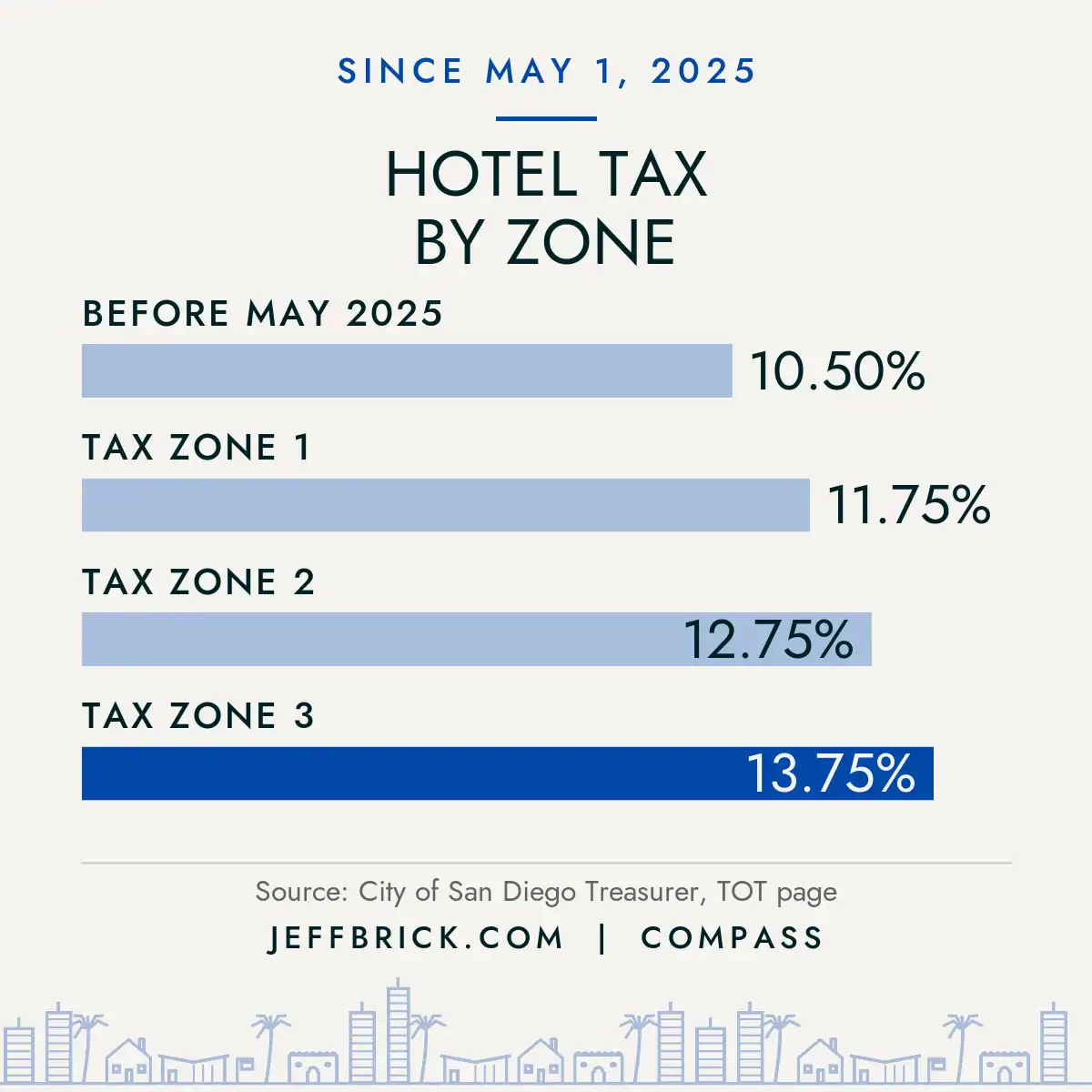
Since May 1, 2025, the TOT has been 11.75%, 12.75% or 13.75%, depending on a property’s tax zone, up from 10.50%. The zone closest to the Convention Center pays the highest rate. You collect the tax with the rent and remit it monthly, by the last day of the following month. The City also requires a Rental Unit Business Tax for rentals of more than six days a year.
This is general information, not legal or tax advice. Please confirm your situation with a California real estate attorney or CPA.
Rules every San Diego STR host must follow
- One license per host. A host may hold one license and operate one dwelling unit as a short-term rental at a time. Licenses are not transferable, so you cannot buy a home and inherit the seller’s license.
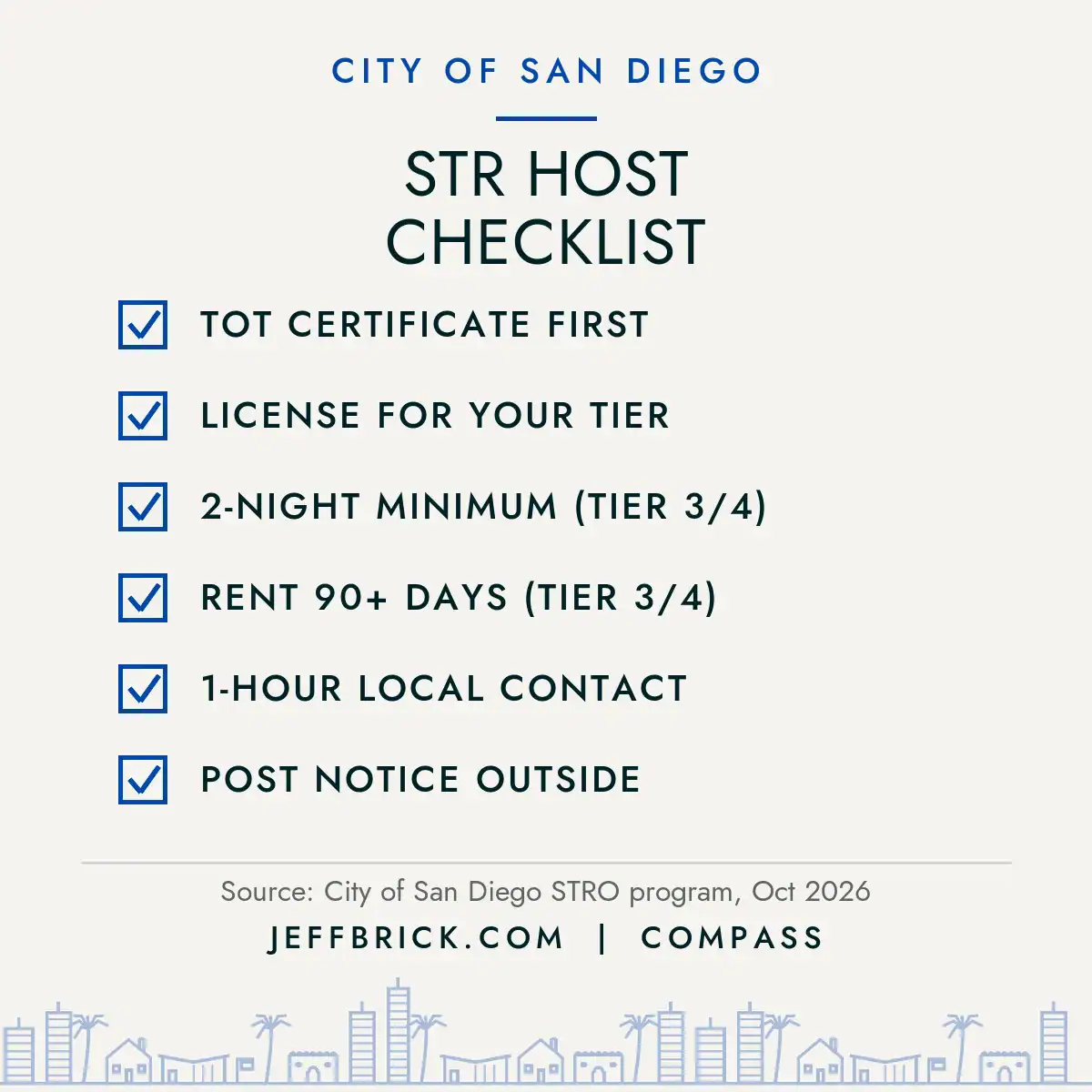
- Two-night minimum for Tier 3 and Tier 4 guests.
- A local contact who responds to complaints in person or by phone within one hour.
- An exterior notice, visible from the sidewalk, showing your TOT certificate number, STRO license number and contact phone.
- The Good Neighbor Policy and quarterly reports (quarterly reports apply to Tier 3 and Tier 4).
- No ADUs. ADUs, RVs and temporary structures cannot be used as short-term rentals, except companion units permitted before October 15, 2017. If you are weighing an ADU for income, my ADU guide covers the long-term rental route.
Break the rules and the City can issue civil penalties or revoke your license. The full ordinance is in the San Diego Municipal Code, Chapter 5, Article 10.
What is changing: the eviction loophole and SB 346
Two developments are worth watching. First, on October 21, 2026, a City Council committee reviewed proposed STRO amendments. As inewsource reported on October 28, the full Council could let the City revoke or deny a license when an owner has violated the Tenant Protection Ordinance. One council staffer said the City “is not going to be proactively looking,” so enforcement would rely on tenant complaints. No date is set for a full Council vote.
Second, at the state level, SB 346 (signed October 13, 2025) lets a city that opts in by ordinance require booking platforms to report rental addresses and show the local license number in listings. Either way, the trend is clear: unlicensed listings are getting easier to find.
A note for renters and 30-day rentals
Both the STRO license and the TOT apply to stays of less than one month, and the City’s TOT rules exempt stays of one month or more. Furnished rentals of 30 days or longer are a different business with different rules, including California landlord-tenant law. And if you rent your home, the loophole debate above is about protecting you.
Outside the City of San Diego
The STRO applies only inside the City of San Diego. Coastal cities such as Oceanside, Carlsbad, Encinitas and Coronado, and the unincorporated county, each set their own rules. Always check with the city where the property sits.
Jeff’s take
As 2026 President of the San Diego Multiple Listing Service, a 2024–2026 director of the San Diego Association of REALTORS® and the largest luxury apartment home leasing broker in Southern California, I watch both sides of this market: owners who want flexible income and renters who need homes. My advice to investors is simple. Underwrite every property as a long-term rental first. If the numbers work at 12-month rents, a short-term license is upside. If the deal only works as an Airbnb, you are betting on a capped, non-transferable license, a 90-day minimum and rules that keep tightening.
Also check the HOA. Many condo associations limit rentals regardless of what the City allows, which I cover in my downtown luxury condo checklist and my condo gap guide for investors.
Let’s run your numbers
Thinking about a San Diego investment property, or wondering whether your home qualifies for a license? Call or text me at 858-324-4448 or send me a note. I’ll help you compare short-term, 30-day and 12-month strategies with real numbers. Million Dollar Service at All Price Points.
Short-term rental rules in San Diego: FAQ
Do I need a license to Airbnb my home in San Diego?
Yes. Inside the City of San Diego, any rental of less than one month needs a STRO license and a TOT certificate, even if you rent for only a few days a year (Tier 1).
How much does a San Diego STR license cost?
$226 for Tier 1, $317 for Tier 2 and $1,170 for Tier 3 or Tier 4, including the application fee. Licenses last two years.
Can I still get a whole-home (Tier 3) license?
As of October 23, 2026, the City showed 807 Tier 3 licenses remaining. Mission Beach (Tier 4) had 0 remaining and runs on a waitlist.
Does a license transfer when I buy a home?
No. STRO licenses are not transferable, and each host may hold only one license at a time.
Can I rent my ADU as a short-term rental?
Generally no. The City does not allow ADUs to be used as short-term rentals, except companion units permitted before October 15, 2017.
About the author: Jeff Brick is a San Diego REALTOR® with Compass (DRE# 02156850), 2026 President of the San Diego Multiple Listing Service, a 2024–2026 member of the San Diego Association of REALTORS® Board of Directors, and the largest luxury apartment home leasing broker in Southern California. Sources: City of San Diego Treasurer STRO and TOT pages (accessed Oct. 30, 2026), City of San Diego news release (Mar. 20, 2025), inewsource (Oct. 28, 2026), California SB 346 (Ch. 751, Stats. 2025).