
Published · By Jeff Brick, 2026 SDMLS President
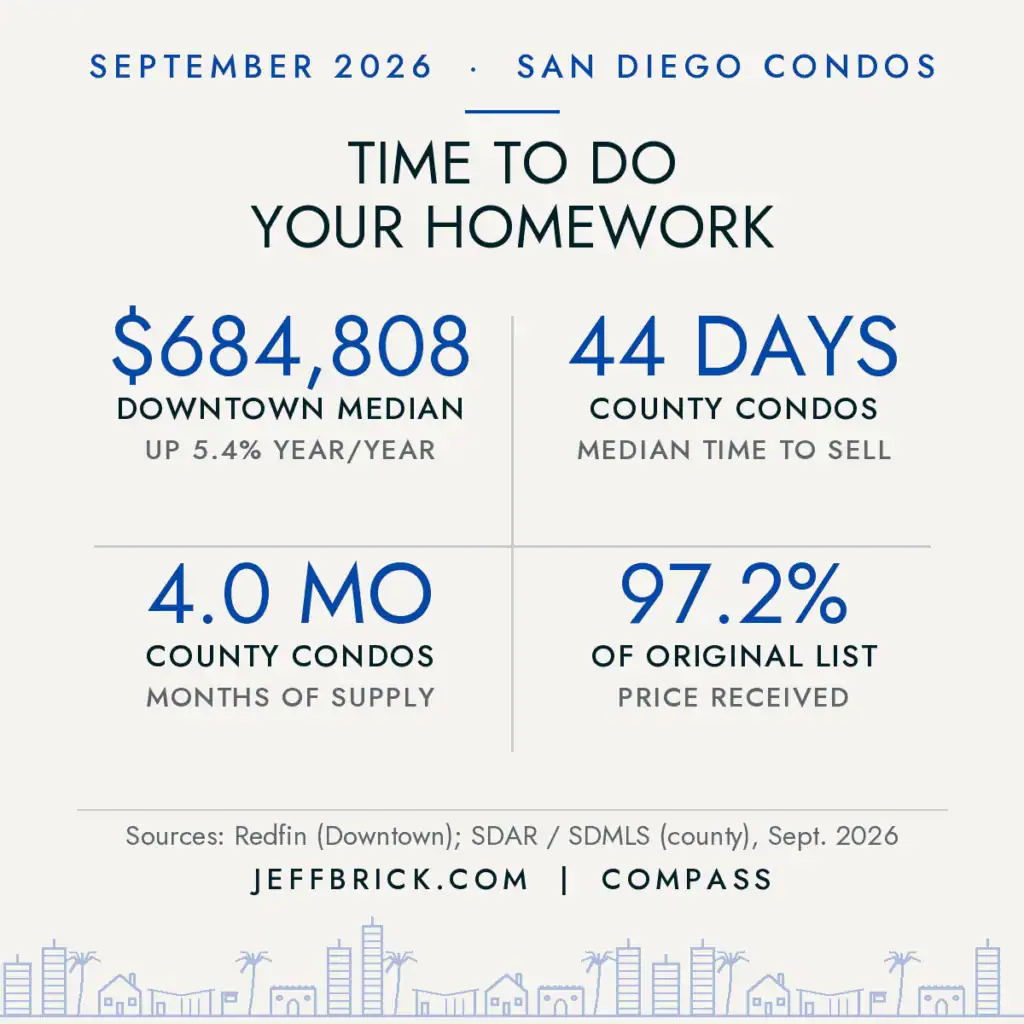
Quick answer: Before you buy one of the luxury condos in downtown San Diego, check five things: the HOA’s reserve funding and recent reserve study, any special assessments or critical repairs, whether the building is approved for the loan you plan to use, the view you are actually paying for, and the rules on renting and parking. The market gives you time to do it. Downtown’s median sale price was $684,808 in September 2026, up 5.4% from a year earlier, while countywide condos and townhomes took a median 44 days to sell with 4.0 months of supply. That is room to read every page before you sign.
This is general information, not legal, tax or financial advice. Confirm HOA, loan and tax questions with a California real estate attorney, a licensed lender and your CPA.
What the downtown San Diego condo market looks like right now
Downtown prices held up better than the county as a whole. Redfin puts the Downtown San Diego median at $684,808 for September 2026, up 5.4% year over year. Across all San Diego MLS attached homes, the median was $670,000, down 0.2%, with 2,734 condos and townhomes for sale (up 5.8%) and closed sales down 14.0%.
For buyers, that mix matters. Sellers received 97.2% of their original list price on average, so luxury condo pricing is firm but not frenzied. You can ask for inspection time, HOA document review time and, in some buildings, seller credits.
For more on why condos have been negotiating differently than houses, see my condo and townhome price reduction breakdown.
Check 1: HOA reserves and the reserve study
In a high-rise, you are buying a share of elevators, roofs, pumps, garage membranes and facade systems. The reserve fund is how those get replaced without a surprise bill. Here is what California law gives you to work with:
- Reserve study. The board must have a visual inspection of major components done at least once every three years and review the study annually.
- Percent funded. The Assessment and Reserve Funding Disclosure Summary shows the projected balance against what is needed, stated as a percent funded, plus a five-year projection.
- Scheduled assessments. The same form lists special assessments already approved, with amounts and due dates.
A lower percent funded is not automatically a deal breaker, but it tells you who pays for the next big project: the reserve fund, or you. Ask what the next three large items are, when they are due, and whether the funding plan covers them.

Check 2: Special assessments, critical repairs and the balcony report
California’s balcony law requires inspection of exterior elevated elements at least once every nine years, with the first round due by January 1, 2025. It covers buildings with three or more units, but only elements supported “in whole or in substantial part by wood”. Many downtown towers are concrete and steel, so ask whether the building was in scope and request the report if it was. Sellers must provide the most recent one under Civil Code section 4525.
Repairs also affect financing. Fannie Mae says loans in projects needing critical repairs “remain ineligible until the repairs have been completed”, even if a special assessment is already funding the work. Ask for 12 months of board minutes, which you can request under section 4525; that is where water intrusion, elevator outages and insurance renewals tend to show up first.
Check 3: Financing, jumbo loans and building approval
Many luxury condos downtown need jumbo financing. The 2026 conforming loan limit in San Diego County is $1,104,000 for one unit, under the FHFA high-cost ceiling of $1,249,125. Put 20% down on a $1.5 million condo and your $1.2 million loan is a jumbo.
The 30-year fixed averaged 7.32% in Freddie Mac’s Oct. 22 survey. At that rate, principal and interest on a $1,104,000 loan run about $7,584 a month before HOA dues, taxes and insurance. The Federal Reserve’s Oct. 27–28 meeting wraps up today, so ask your lender how a lock fits your escrow timeline. My luxury buyer’s Fed playbook covers that strategy.
For conforming loans, the building matters as much as you do. Fannie Mae looks for a minimum 10% budgeted reserve allocation in the HOA budget. Jumbo lenders run their own condo reviews, so have your lender review the building before you write an offer.
Check 4: Views, floor and exposure
Views are the most emotional part of a high-rise purchase and the easiest to overpay for. A few checks I walk through with clients:
- Protected or borrowed? A bay view across a surface parking lot can disappear with one new tower. Look at what is planned on neighboring parcels.
- Direction and light. West and south exposures get sunsets and heat. Ask about window film, shades and the cooling bill.
- Noise. Visit at night and on a weekend. Airport approaches, Petco Park events and Gaslamp nightlife sound different on the 8th floor than the 28th.
- Compare like for like. Price the same floor plan on different floors and exposures in the same building, not just square footage.
Check 5: High-rise living rules, parking and rentals
Read the CC&Rs and house rules for move-in reservations, pet limits, renovation hours and guest parking. Count your deeded or assigned spaces, because downtown parking is its own luxury. If you might rent the unit later, California generally bars HOAs from banning rentals or capping them below 25% of units, but associations can still prohibit stays of 30 days or less, so do not count on short-term rental income.
A note for downtown renters
If you lease in a luxury high-rise today, you already know which amenities you use. Make that your shopping list. Your rent check carries no reserve study, but the condo you buy will, so build HOA dues into your monthly comparison. My rent-or-buy breakdown runs the numbers.
A note for investors
Reserve health, rental rules and financing approval drive resale and rentability. My condo gap guide for investors goes deeper on the numbers.
Jeff’s take
I’ve worked in San Diego real estate since 1999. The best downtown condo buyers fall in love with the view and then make the building earn it. As the 2026 President of the San Diego Multiple Listing Service, a Board Director of the San Diego Association of REALTORS® and the largest luxury apartment home leasing broker in Southern California, I spend a lot of time inside high-rise towers, and the difference between two similar units is usually in the HOA binder, not the brochure. With inventory up and homes taking longer to sell, you have the leverage to ask for documents, time and credits. Use it. Million Dollar Service at All Price Points means a $685,000 condo gets the same scrutiny as a $3 million penthouse.
Let’s tour downtown together
Thinking about a luxury condo in the Marina, Little Italy, East Village or Columbia? Call or text me at 858-324-4448 or book a home buying consultation. I’ll help you shortlist buildings, pull the HOA documents and pressure-test the numbers. Everyone is welcome home.
FAQ
What should I check before buying a luxury condo in downtown San Diego?
Review the HOA reserve study and percent funded, any approved special assessments, the balcony inspection report if the building is in scope, 12 months of board minutes, rental and pet rules, parking, and whether the building qualifies for your loan.
How often do California HOAs have to update their reserve study?
The board must have a visual inspection of major components at least once every three years and review the reserve study every year under Civil Code section 5550.
Does California’s balcony inspection law apply to downtown high-rises?
It applies to buildings with three or more units, but only to elevated elements supported in whole or substantial part by wood. Many concrete and steel towers fall outside it, so ask the HOA.
Will I need a jumbo loan for a downtown San Diego luxury condo?
If your loan is above $1,104,000, the 2026 conforming limit for one unit in San Diego County, it is a jumbo loan. A $1.5 million condo with 20% down needs a $1.2 million loan.
What is the median price of a downtown San Diego condo?
Redfin reported a Downtown San Diego median sale price of $684,808 in September 2026, up 5.4% from a year earlier. Luxury units sell well above that.
Jeff Brick, REALTOR® at Compass, DRE# 02156850. 2026 President, San Diego Multiple Listing Service; Board of Directors, San Diego Association of REALTORS® (2024–2026); the largest luxury apartment home leasing broker in Southern California.