

Published · Updated · By Jeff Brick, 2026 SDMLS President
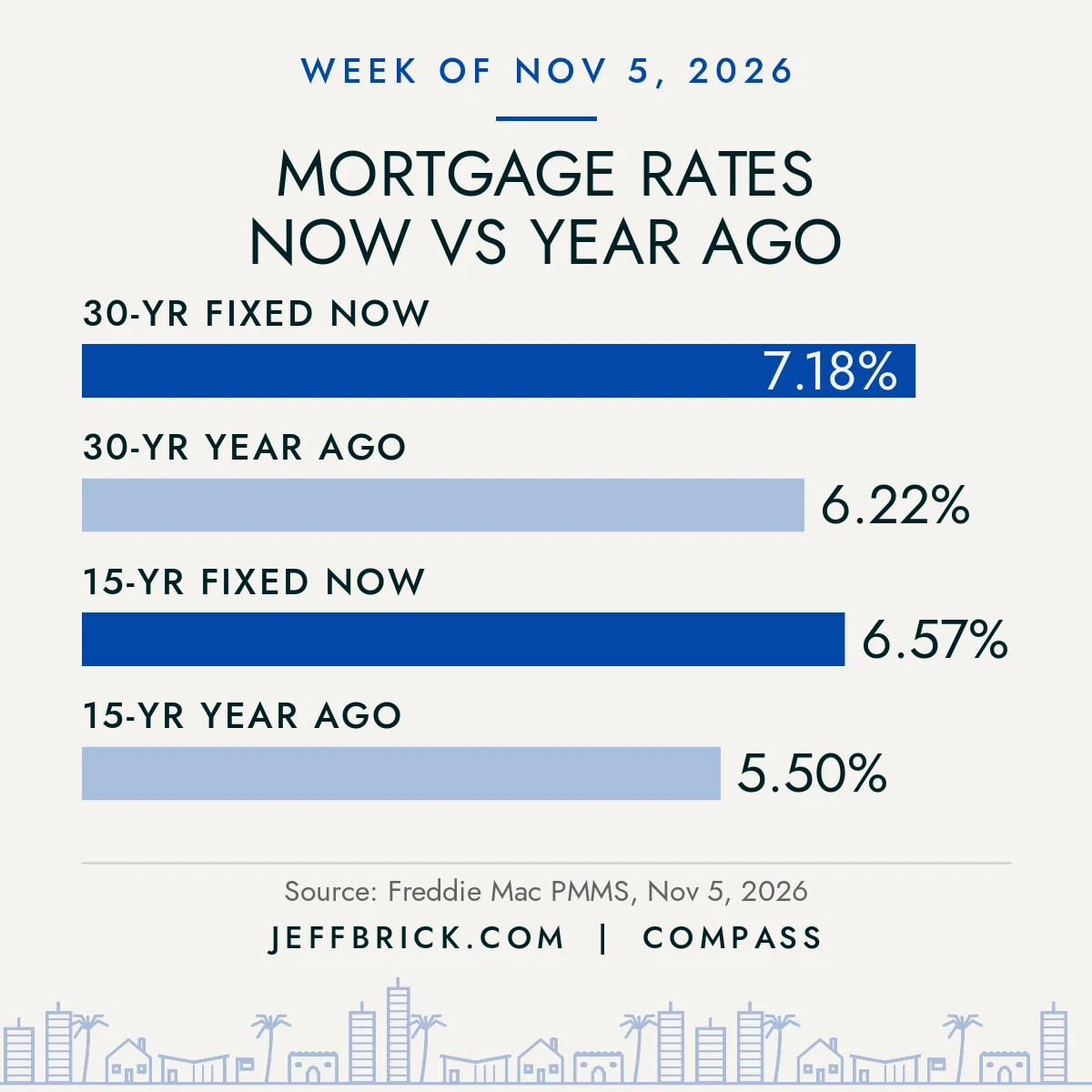
Quick answer: To decide whether a duplex for sale in San Diego is a good buy, start with real rents, subtract vacancy and every operating expense to get net operating income (NOI), divide NOI by price for the cap rate, then compare NOI with your mortgage payment. With the 30-year fixed averaging 7.18% in Freddie Mac’s November 5, 2026 survey, most San Diego 2-4 unit properties will not cash flow with a typical investor down payment. They often make more sense as an owner-occupied home where a tenant helps pay the mortgage, and 2026 conforming loan limits in San Diego County go up to $1,413,350 for a two-unit property.
This is general information, not legal, tax or financial advice. Loan terms, taxes and rent rules depend on your situation, so confirm the details with your lender, CPA and attorney before you write an offer.

Why small multifamily is its own game in San Diego
Duplexes, triplexes and fourplexes sit in a sweet spot. They are still financed as residential property (one to four units), yet they produce rent like an apartment building. You see them tucked into older, walkable neighborhoods such as North Park, Normal Heights, University Heights, Ocean Beach and Pacific Beach. You can compare every area in my San Diego neighborhood guides.
The catch: these properties are priced by a market full of owner-occupants who care about lifestyle, not just yield. That pushes prices up and cap rates down. So the decision is rarely “is this a good investment?” in the abstract. It is “does this work for my plan: live in one unit, hold for appreciation, or buy for cash flow?”
Step 1: Run the numbers the right way
Gross rent and vacancy
Use the rents tenants actually pay today, from signed leases and bank deposits, not the “pro forma” rents in the marketing. Then subtract a vacancy and collection allowance. I use 5% as a starting point for well-located small multifamily, and more if a unit needs work between tenants.
Operating expenses
Include property taxes at your purchase price (the seller’s old tax bill does not carry over), insurance, repairs, capital reserves for roofs and water heaters, any utilities the owner pays, landscaping, and management even if you plan to self-manage. Do not include your mortgage here.
NOI, cap rate, DSCR and cash-on-cash
- NOI = effective gross income minus operating expenses.
- Cap rate = NOI divided by purchase price. It measures the property, not your loan.
- DSCR (debt service coverage ratio) = NOI divided by annual principal and interest. Below 1.0 means the rent does not cover the mortgage.
- Cash-on-cash return = annual cash flow after the mortgage divided by the cash you put in.
A worked example (made-up numbers, real math)
Here is a hypothetical duplex so you can see how the pieces fit. The price, rents and expenses below are round illustrative numbers, not market data; plug in the real figures for any property you are considering.
- Price: $1,400,000. Two units at $3,200 a month each = $76,800 a year.
- Less 5% vacancy = $72,960 effective gross income.
- Expenses: property tax assumed at 1.2% of price ($16,800), insurance $4,200, repairs $3,840, reserves $3,840, owner-paid utilities $2,400 = $31,080.
- NOI = $41,880, so the cap rate is about 3.0%.
Now add financing at the current Freddie Mac 30-year average of 7.18%. With 25% down, a $1,050,000 loan costs about $7,113 a month in principal and interest, or about $85,357 a year. The DSCR is roughly 0.49, and the property loses about $43,500 a year before you count appreciation or tax benefits. That is negative leverage: the property yields about 3% while the debt costs more than 7%.
A handy rule of thumb from the same math: at 7.18% on a 30-year loan with 25% down, a property needs a cap rate of roughly 6.1% just for the rent to cover principal and interest. Rates on investment and 2-4 unit loans often price above the survey average, so ask your lender for a real quote. You can test your own scenarios with my San Diego mortgage calculator.
Step 2: Choose your strategy
Owner-occupied: live in one unit, rent the rest
This is where small multifamily shines for first-time buyers and newer investors. Fannie Mae’s Eligibility Matrix allows up to 95% loan-to-value on a 2-4 unit principal residence purchase underwritten through Desktop Underwriter, which means as little as 5% down for qualified buyers (mortgage insurance applies). In the example above, 5% down would mean a $1,330,000 loan, which fits under San Diego County’s 2026 two-unit conforming limit. Your tenant’s rent offsets part of your payment, so compare your net monthly cost with what you pay in rent today. If you need help with the down payment, see my guide to down payment help in San Diego County.
Pure investor: buy for cash flow
Investors usually need a larger down payment and face higher rates, so the bar is higher. Look for below-market rents with room to grow under the law, value-add work, an extra lot or garage that could become an ADU (see my ADU guide), or a price that gets you closer to that 6% range. If you are counting on short-term rental income, read my San Diego short-term rental rules first, and if condos are on your list, compare with my condo investor guide.
Step 3: Know your loan limits
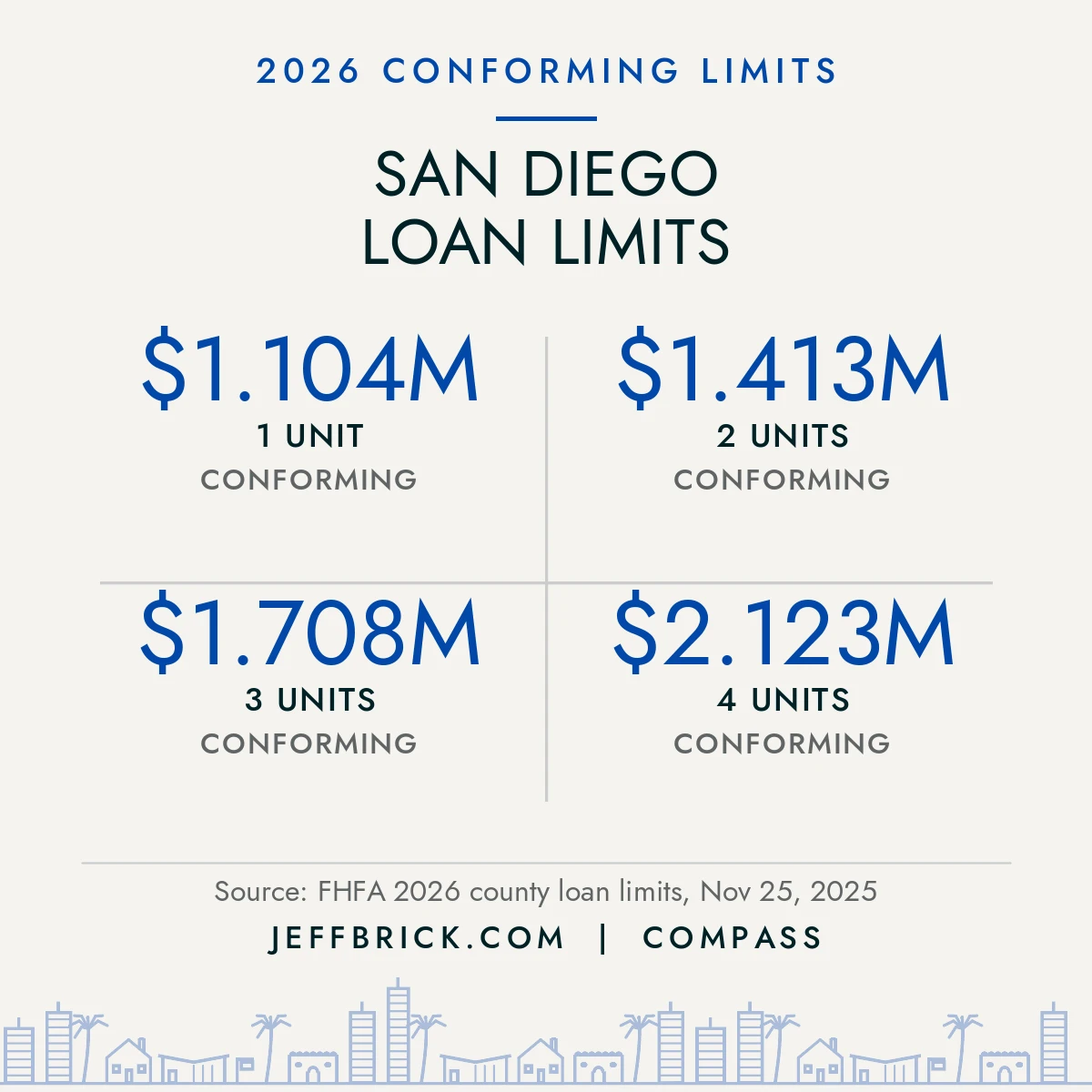
Conforming loan limits are higher for more units. For 2026, FHFA set the baseline one-unit limit at $832,750, and its county list shows San Diego County at $1,104,000 for one unit, $1,413,350 for two, $1,708,400 for three and $2,123,100 for four. Above those amounts you are in jumbo territory, with different down payment and pricing rules.
Step 4: Check the rent rules (and the renter’s side)
California’s Tenant Protection Act caps annual increases at 5% plus the change in cost of living, or 10%, whichever is lower. The California Attorney General’s rent cap chart lists 8.2% for San Diego County increases taking effect from August 1, 2026 through July 31, 2027. There is an important exemption for a duplex (two units in a single structure, neither an ADU) where the owner lives in one unit at the start of the tenancy and keeps living there, as the Attorney General’s tenant page explains. Triplexes and fourplexes do not get that duplex exemption, and other exemptions and just-cause rules can apply, so have an attorney review your leases.
For renters, the takeaway is the flip side: if you rent in a 3-4 unit building or a non-owner-occupied duplex, those caps generally protect you. And if you are renting today and dreaming of ownership, a duplex can be a bridge: you become the landlord and a tenant helps carry the mortgage.
Step 5: Inspect before you commit
Older small multifamily often hides deferred maintenance: shared sewer lines, aging electrical panels, unpermitted units and roofs at the end of their life. Budget for a general inspection, sewer scope and pest inspection, and verify permits for every unit with the City. My approved vendors directory lists inspectors, lenders and contractors I trust.
Jeff’s take
I have worked San Diego real estate since 1999, and I serve as 2026 President of the San Diego Multiple Listing Service, on the San Diego Association of REALTORS® Board of Directors, and as a Southern California luxury apartment home leasing broker. That rental side of my business is why I am blunt about duplex math: at today’s rates, very few San Diego 2-4 unit properties pay for themselves with 25% down. The ones that win are bought for a clear reason: you live in one unit, you can add value, or you are holding for the long run with reserves to ride it out. Buy the plan, not the brochure.
Want me to run the numbers on a duplex with you?
Send me any San Diego duplex, triplex or fourplex you are eyeing and I will help you check the rents, expenses, loan limits and rent rules before you write an offer. Call or text me at 858-324-4448 or send me a message. Jeff Brick, REALTOR®, Compass, DRE# 02156850. Million Dollar Service at All Price Points.
Small multifamily San Diego FAQ
What is a good cap rate for a duplex in San Diego?
There is no single “good” number, but compare it with your borrowing cost. At a 7.18% 30-year rate with 25% down, a property needs roughly a 6.1% cap rate for rent to cover principal and interest. Many San Diego duplexes trade well below that, so owner-occupants and long-term holders are often the strongest buyers.
Can I buy a duplex in San Diego with 5% down?
Possibly, if you will live in one of the units. Fannie Mae’s Eligibility Matrix allows up to 95% loan-to-value on a 2-4 unit principal residence purchase through Desktop Underwriter. Investors buying a property they will not live in need more down.
What is the 2026 loan limit for a duplex in San Diego County?
FHFA’s 2026 county list sets San Diego County’s conforming limit at $1,413,350 for two units, $1,708,400 for three units and $2,123,100 for four units.
Does California’s rent cap apply to my duplex?
Not if you live in one unit at the start of the tenancy and keep living there, under the Tenant Protection Act’s owner-occupied duplex exemption. Otherwise, increases are generally limited to 5% plus inflation, capped at 10%, and the Attorney General lists 8.2% for San Diego County from August 2026 through July 2027.
How do I calculate cash flow on a small multifamily property?
Start with actual rents, subtract vacancy and all operating expenses to get NOI, then subtract your annual principal and interest. What is left is your cash flow; divide it by the cash you invested for your cash-on-cash return.