

Published · By Jeff Brick, 2026 SDMLS President
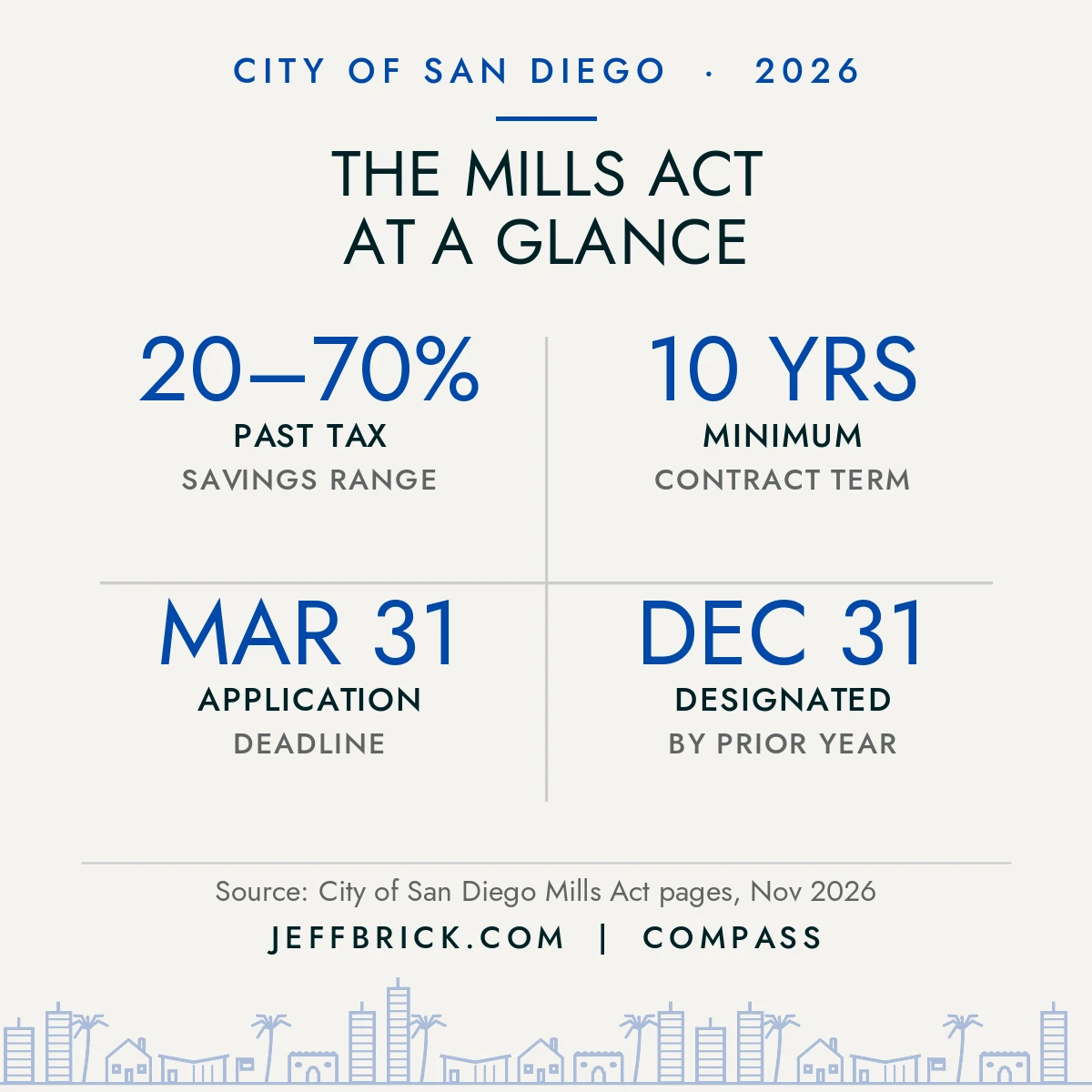
Quick answer: The Mills Act is a California law that lets owners of designated historic homes trade a 10-year preservation agreement for a lower property tax bill. In the City of San Diego, the City says savings have ranged from 20% to 70%. To qualify, your home must be on the City’s Register of Historical Resources (individually or as a district contributor) by December 31, and you apply between January 1 and March 31. The agreement stays with the house when it sells.
This is general information, not legal, tax or financial advice. Mills Act savings depend on the County Assessor’s valuation of your specific property, so confirm the numbers with the City’s historic preservation staff, the Assessor and your tax professional before you count on them.
What the Mills Act is, in plain English
California passed the Mills Act in 1972. According to the California Office of Historic Preservation, it lets cities and counties sign contracts with owners of qualified historic properties who agree to preserve and maintain them. In return, the County Assessor values the property with the income approach (based on what comparable homes would rent for, divided by a capitalization rate) instead of the usual market approach. For many San Diego homes bought in recent years, that produces a meaningfully lower assessed value.
The City of San Diego adopted its program in 1995 under Council Policy 700-46. The County of San Diego runs the program for unincorporated areas, and other cities in the county set their own rules, so always check with the city where the home sits. The San Diego County Assessor says it revalues the home “beginning the next full tax year” after it gets notice of the agreement.
Who qualifies in the City of San Diego
The key word is local. The City is clear that local historical designation is required: a National Register or California Register listing alone does not qualify. Your home must be designated by the City’s Historical Resources Board, either on its own or as a contributing home inside a designated historic district.
- Designation deadline: the home must be designated by December 31 of the year before you apply.
- Application window: complete applications are accepted only from January 1 to March 31.
- Visibility: the policy requires the exterior to be visible from the public right-of-way.
- A 10-year plan: you submit a schedule of restoration and maintenance work with contractor cost estimates, and the City will not process an application unless the tax savings are being invested back into the historic property.
- Budget cap: the policy sets an annual threshold of $200,000 in new General Fund property tax reductions; applications above it can roll to the next year unless the City Council approves them.
Those deadlines matter for timing. Designation is its own public process with its own fee, so if you are buying in a historic neighborhood this winter and the home is not yet designated, the realistic Mills Act path starts with a designation application and lands in a future tax year.
What it costs to get there
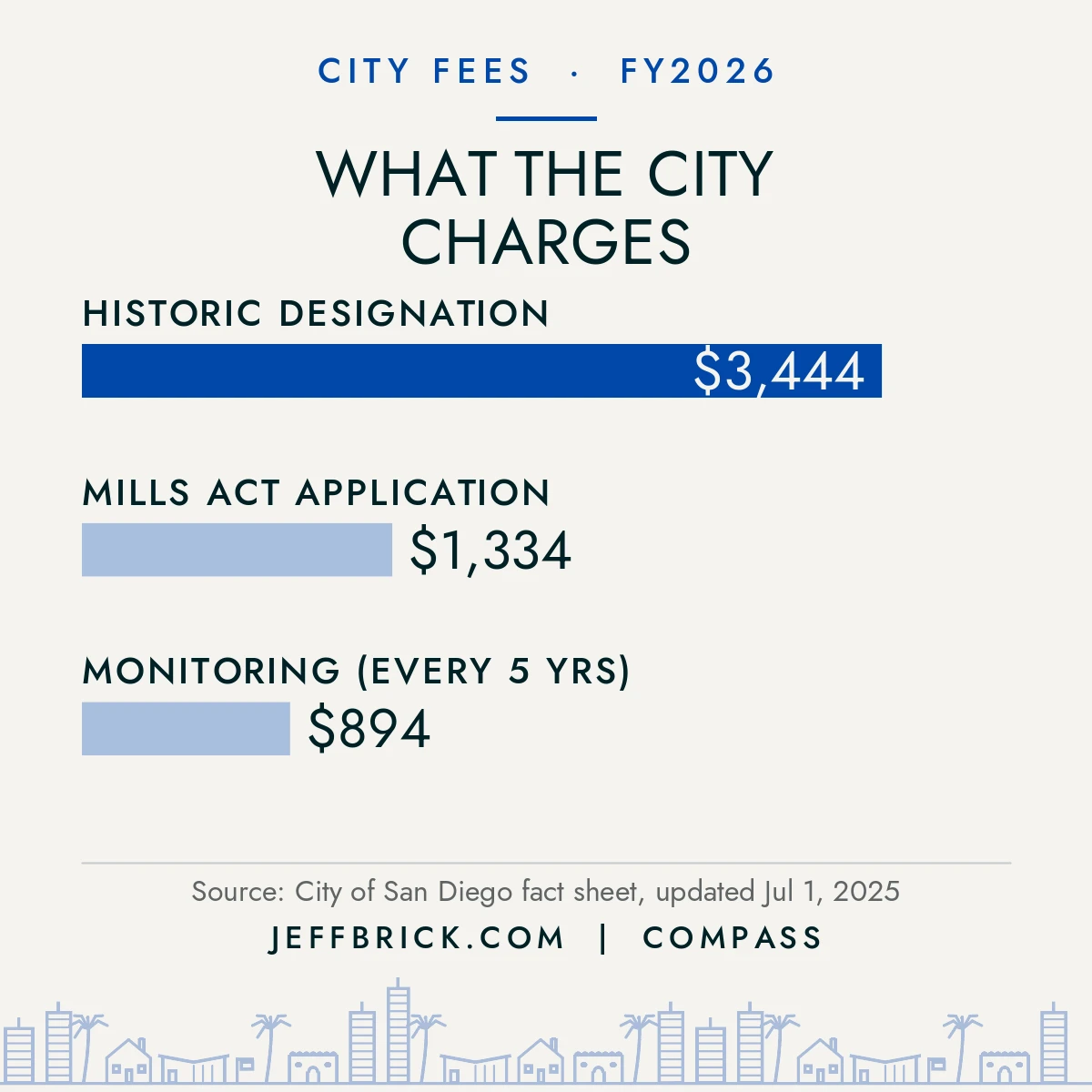
The City charges fees at each step. Per the City’s Mills Act fact sheet (fees updated July 1, 2025): $3,444.36 for the historic designation process, $1,334.24 for the Mills Act application, and $893.67 for monitoring, due when the agreement is signed and every five years after. Separately, most owners hire a historic consultant to prepare the designation report, and you will want real contractor bids for your 10-year plan. When you need roofers, painters or window restorers who understand older homes, start with my Approved Vendors list.
How much could you actually save?
The honest answer is: it depends on the house. The City’s web pages say savings have ranged from 20% to 70%, and the City’s fact sheet cites an average of about 50%. The savings tend to be largest for homes bought recently at today’s prices, because the income approach can land well below a fresh Prop 13 purchase value. Owners who bought decades ago may already have a low assessed value and see little benefit.
Simple illustration, not a promise: if your annual property tax bill were $15,000, a 20% to 70% reduction would mean roughly $3,000 to $10,500 a year. Over a 10-year agreement, that is real money to put into a new roof, original wood windows or a seismic retrofit. Only the Assessor can tell you your actual number, so ask for an estimate before you commit.
The fine print: obligations and penalties
It renews itself every year
State law sets a minimum term of 10 years, and the City’s agreement renews automatically each year so that 10 years always remain. If either side sends a notice of non-renewal, the agreement runs out about 10 years later and the tax benefit phases out with it.
You must maintain the home to preservation standards
Owners agree to maintain the home under the Secretary of the Interior’s Standards, and City staff monitor compliance with site visits on a five-year cycle. Unpermitted changes to the historic features can put the agreement at risk.
Breaking it is expensive
If a city cancels an agreement for breach, Government Code section 50286 requires a cancellation fee equal to 12.5% of the home’s current fair market value, as determined by the Assessor without the contract restriction. On a $1.5 million home, that is $187,500. Treat a Mills Act agreement as a long-term commitment, not a quick tax trick.
It transfers when you sell
In the words of the City’s Mills Act FAQ, “the Mills Act benefits go with the land.” New owners inherit both the lower taxes and the obligations. For sellers, that can be a strong marketing point. For buyers, it means reading the recorded agreement and the 10-year work plan during escrow, just like you would read HOA documents.

Where San Diego’s Mills Act homes are, and what they cost
You will find designated homes and historic districts across the city’s older neighborhoods, including Mission Hills, North Park, Kensington, Talmadge, South Park, Golden Hill, University Heights, Bankers Hill and Point Loma. You can browse all of my San Diego neighborhood guides, and my earlier historic neighborhoods market guide and modernist homes guide go deeper on architecture.
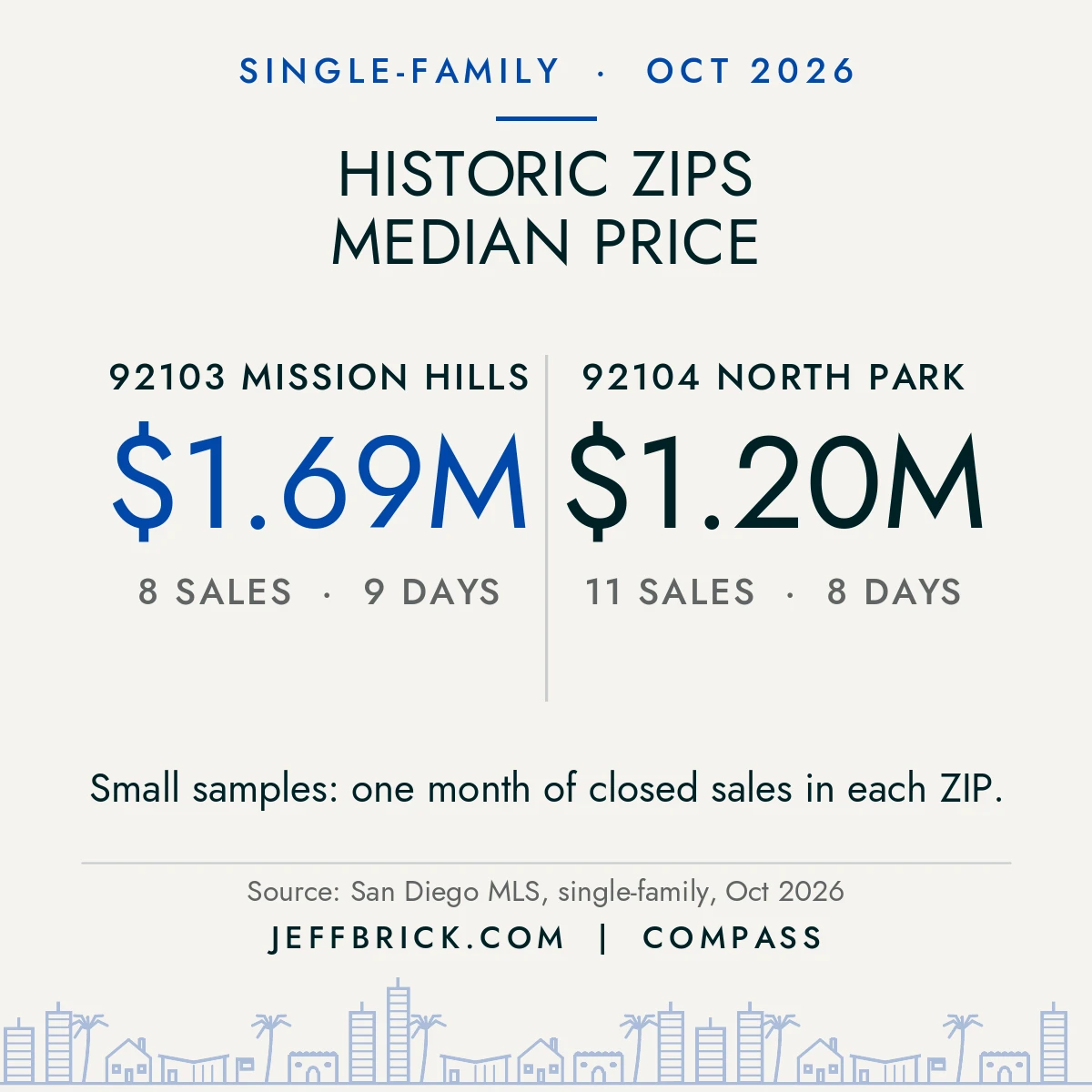
Here is what single-family homes sold for last month in two historic-core ZIPs. San Diego MLS, October 2026: the median single-family price in 92103 (Mission Hills, Hillcrest and Bankers Hill) was $1,693,500 across 8 sales, compared with $1,820,000 a year earlier, with a median of 9 days on market. In 92104 (North Park), the median was $1,200,000 across 11 sales, up from $1,145,000, with a median of 8 days on market. Both are small one-month samples (92103 had fewer than 10 sales), so read them as a snapshot, not a trend. For more on North Park, see my guide to living in North Park.
Why it matters right now: Freddie Mac’s survey put the average 30-year fixed rate at 7.24% on Oct. 29, 2026. When rates are this high, every line of the monthly payment counts, and a lower property tax bill on a Mills Act home can help offset some of that cost.
A note for sellers, investors and renters
Sellers: if your home already has an agreement, gather the recorded contract, your work plan and receipts before listing. Buyers pay attention when they can see the tax savings and the care that went into the house. Investors: rental homes can qualify, but the Assessor’s income approach and your maintenance duties both change the math, so model it carefully. Renters: many historic bungalows are rentals today, and the Mills Act does not change your lease terms; it simply rewards the owner for keeping the home in great shape.
Jeff’s take
I have sold historic homes in San Diego since 1999, and the Mills Act is one of the most underused tools in our market. I see buyers fall in love with a 1920s Craftsman in North Park or a Spanish Revival in Kensington, then flinch at the tax bill. For the right home and the right owner, a Mills Act agreement can turn that flinch into a plan. But it is a 10-year relationship with the City, so go in with eyes open: confirm designation status, get the Assessor’s estimate and budget for the preservation work you are promising. As a REALTOR® at Compass, 2026 President of the San Diego Multiple Listing Service, a 2024–2026 member of the San Diego Association of REALTORS® Board of Directors and the largest luxury apartment home leasing broker in Southern California, my promise is the same on every deal: Million Dollar Service at All Price Points.
Thinking about a historic home? Let’s talk.
Whether you want to buy a home that already has a Mills Act agreement, explore designation for the home you own, or sell a historic property to the buyers who will value it most, call or text me at 858-324-4448 or send me a message. Jeff Brick, REALTOR®, Compass, DRE# 02156850.
Mills Act San Diego FAQ
Does a National Register listing qualify my home for the Mills Act in San Diego?
Not by itself. In the City of San Diego, the home must be locally designated on the City’s Register of Historical Resources, either individually or as a contributor to a designated historic district.
When can I apply for a Mills Act agreement?
The City accepts complete applications only from January 1 to March 31, and the home must have been designated by December 31 of the prior year.
How much does the Mills Act lower property taxes?
The City reports savings ranging from 20% to 70%, depending on the property. The County Assessor calculates the actual value using the income approach, so ask for an estimate for your home.
Does the Mills Act transfer to a new owner?
Yes. The agreement is recorded against the property and runs with the land, so new owners inherit both the tax benefit and the preservation obligations.
What happens if I break a Mills Act agreement?
If the agreement is canceled for breach, state law requires a cancellation fee of 12.5% of the property’s current fair market value. Owners can instead give notice of non-renewal, which lets the agreement wind down over the remaining term.