
Published · By Jeff Brick, 2026 SDMLS President
Quick answer: On October 28, 2026, the Federal Reserve held its benchmark rate at 3.75%–4.00% on a 10–2 vote, with two members wanting another hike. Mortgage rates didn’t wait for the Fed: Freddie Mac’s 30-year fixed average eased to 7.24% on October 29, down from 7.40% in mid-October. For San Diego buyers, that is a small but real break, and the bigger opportunity may be knowing exactly where jumbo financing starts in our county ($1,104,000 in 2026). Here’s my plain-English recap of the Fed rate decision, mortgage rates and what it all means for your next move.
What the Fed decided on October 28
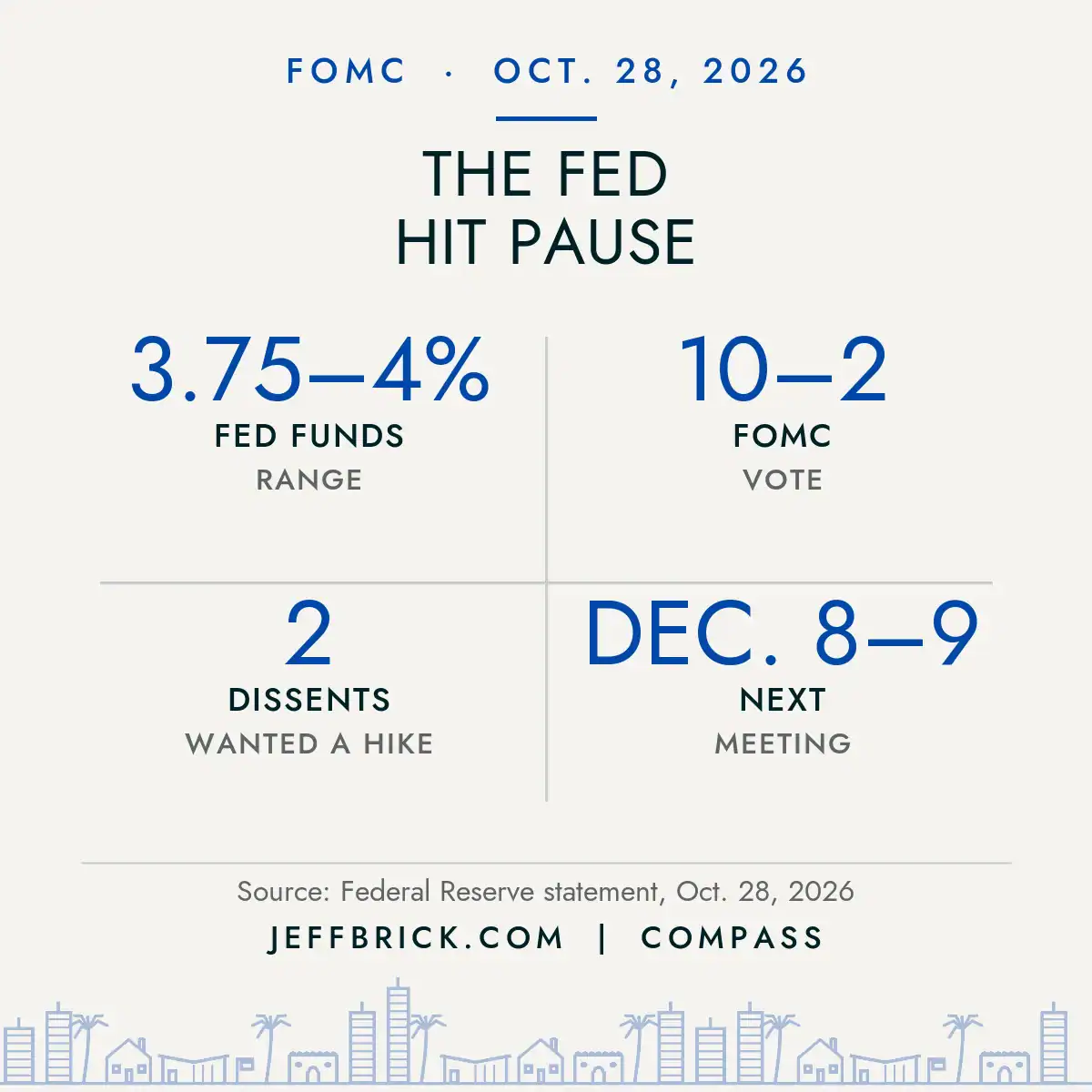
After raising rates by a quarter point in September, the Federal Open Market Committee chose to pause. According to the Fed’s October 28 statement, the federal funds target range stays at 3.75%–4.00%. The vote was 10–2: Governor Lisa D. Cook and Cleveland Fed President Beth M. Hammack both preferred to raise rates another quarter point.
The statement’s tone stayed firm. It described the economy as “expanding at a strong pace” and repeated that “Inflation remains elevated.” At the press conference, Chair Kevin Warsh said, “It’s our responsibility to get inflation down,” as reported by Fox Business. The next scheduled meeting is December 8–9.
Why a “pause” with two hawkish dissents matters
A hold with two votes for a hike tells us the Fed isn’t done worrying about inflation. That’s a signal for buyers not to count on a quick drop in mortgage rates. It also reminds us that the Fed doesn’t set mortgage rates directly. Mortgage rates follow the bond market, which reacts to inflation, jobs data and what investors expect the Fed to do next.
Where the 30-year fixed rate stands now
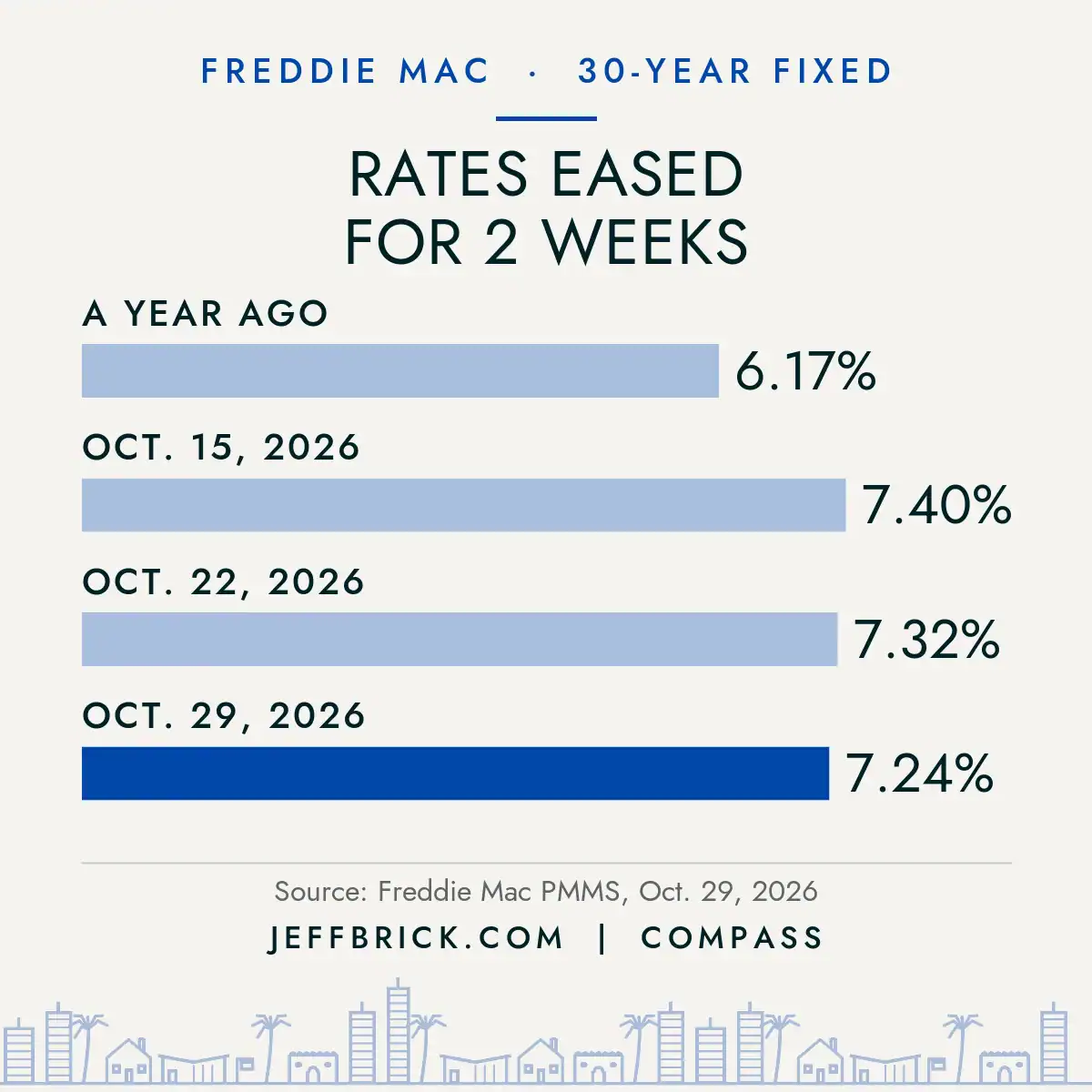
Here’s the good news. The Freddie Mac Primary Mortgage Market Survey shows the 30-year fixed rate averaged 7.24% for the week of October 29, down from 7.32% the week before and 7.40% on October 8 and 15. The 15-year fixed fell to 6.60%. Freddie Mac Chief Economist Sam Khater noted the 30-year rate was “reaching its lowest level this month” (Freddie Mac release).
The less-good news: a year ago, the 30-year averaged 6.17%. So rates are easing within a high range, not returning to last year’s levels. You can see the full weekly trend in this table of Freddie Mac weekly averages.
What the dip means for your monthly payment
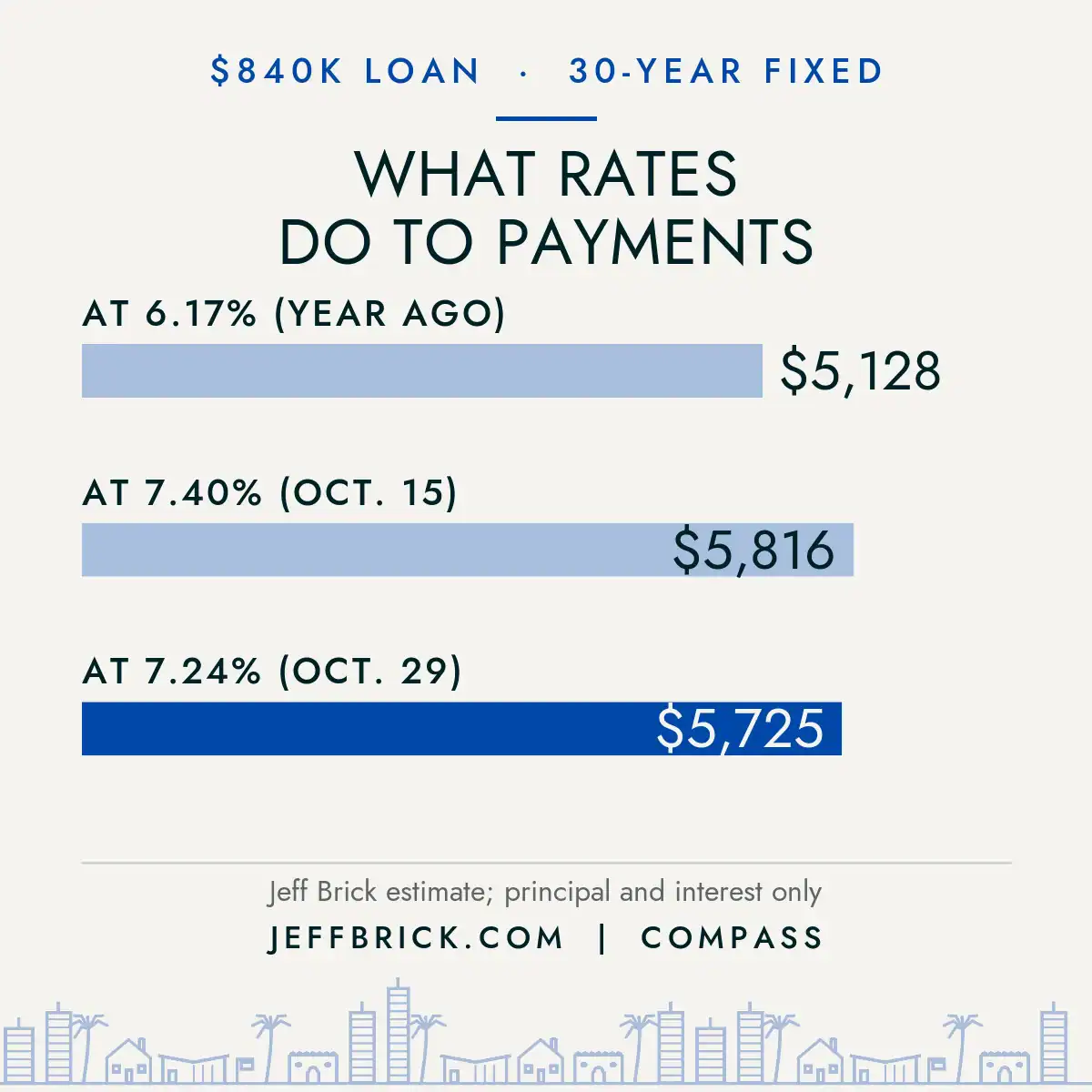
Let’s make it real. San Diego County’s median price was $1,050,000 in September, up 6.1% from a year earlier, according to C.A.R. With 20% down, that’s a loan of about $840,000. My estimates for principal and interest on a 30-year fixed loan:
- At 7.40% (October 15): about $5,816 a month
- At 7.24% (October 29): about $5,725 a month, roughly $91 less
- At 6.17% (a year ago): about $5,128 a month
These are illustrations, not loan quotes, and they leave out property taxes, insurance and HOA dues. They show two things: the recent dip helps a little, and a seller-paid rate buydown can still move your payment more than a modest price cut.
Jumbo loan rates in San Diego: where “jumbo” actually starts
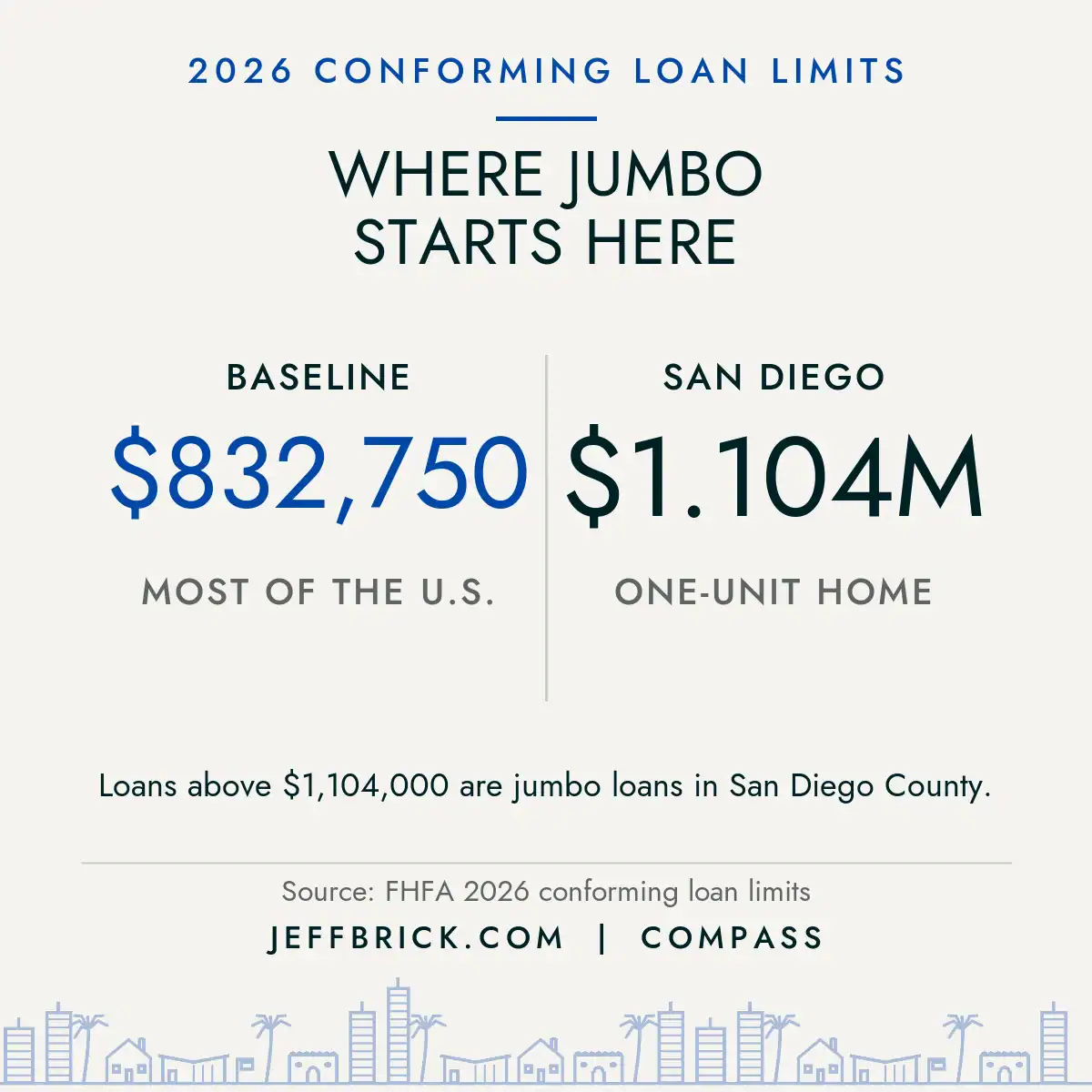
This is the part I wish more San Diego buyers knew. Nationally, the baseline conforming loan limit for 2026 is $832,750. But San Diego County is a high-cost area, so our one-unit limit is $1,104,000, according to the Federal Housing Finance Agency (county list). For two- to four-unit properties, the limits are higher: $1,413,350 for a duplex, $1,708,400 for a triplex and $2,123,100 for a fourplex.
Why it matters: that $840,000 loan on a median-priced home is above the national baseline but still within San Diego’s conforming limit. It’s a “high-balance” conforming loan, not a jumbo. True jumbo loans start above $1,104,000 here, which mostly means luxury purchases in places like La Jolla, Del Mar, Coronado and Rancho Santa Fe.
If you’re shopping in that price range, ask at least three lenders to quote both a high-balance conforming loan and a jumbo loan. Jumbo pricing and underwriting vary a lot between lenders, and reserves, credit and documentation drive your rate as much as the Fed does.
What San Diego buyers should do now
First-time and move-up buyers
- Get fully underwritten, not just pre-qualified. When rates dip, competition picks up. Be ready to move the same week.
- Ask about a rate lock with a float-down option. With the Fed meeting again December 8–9, some protection against a jump is worth discussing with your lender.
- Negotiate on the payment. Seller credits toward a buydown can stretch further than a small price cut. My guide on how much you need to buy a home in San Diego walks through the full budget.
Luxury buyers
Know which side of $1,104,000 your loan falls on. Sometimes a slightly larger down payment keeps you in conforming territory and simplifies approval. If you’re buying downtown, my checklist for luxury condos in downtown San Diego covers HOA reserves and other details lenders look at closely.
A quick note for sellers and renters
Sellers: buyers are shopping by monthly payment, so price for today’s 7.24% buyer and consider offering a buydown credit. Renters who are thinking about buying: you don’t need to time the Fed. Set your target payment first, then watch rates against it. My rent-or-buy breakdown shows how to compare the two.
This is general information, not financial or lending advice. Confirm loan options, rates and limits with a licensed mortgage professional.
Jeff’s take
I’ve worked through a lot of Fed cycles since 1999, and here’s what I’ve learned: the headline almost never changes your best move by much. This week’s message is “steady, with a lean toward caution.” Rates eased a bit, San Diego prices are still up year over year, and the Fed has made it clear it isn’t ready to cut. As 2026 President of the San Diego Multiple Listing Service, a San Diego Association of REALTORS® Board Director and the largest luxury apartment home leasing broker in Southern California, I see both sides of this market every day: buyers watching payments closely, and high-rise renters getting ready to own when the numbers line up. My advice is the same for both: build your plan around the payment you’re comfortable with, get your financing locked down, and let the right home, not the Fed calendar, decide your timing. For the run-up to this meeting, see my luxury buyer’s Fed playbook.
Let’s run your numbers
Want to see what today’s rates mean for the homes you’re actually considering, whether that’s a North Park bungalow, a downtown high-rise or a coastal estate? I’ll bring Million Dollar Service at All Price Points to your search. Call or text me at 858-324-4448, or book a home buying consultation.
FAQ
Did the Fed raise rates on October 28, 2026?
No. The Fed held the federal funds range at 3.75%–4.00% on a 10–2 vote. Two members preferred a quarter-point hike. The next meeting is December 8–9.
What is the 30-year fixed mortgage rate right now?
Freddie Mac’s national average was 7.24% for the week of October 29, 2026, with the 15-year at 6.60%. Your rate depends on credit, down payment, loan size and loan type.
Does the Fed decision set mortgage rates?
Not directly. Mortgage rates follow the bond market, which reacts to inflation, jobs data and expectations about future Fed moves. That’s why rates eased in late October even though the Fed held steady.
What is the jumbo loan limit in San Diego County for 2026?
The 2026 conforming limit for a one-unit home in San Diego County is $1,104,000. Loans above that amount are jumbo loans. The national baseline limit is $832,750.
Should I wait for rates to drop before buying in San Diego?
Nobody can promise when rates will fall, and San Diego’s median price was still up 6.1% year over year in September. If the payment works for you today, buying with a plan to refinance later can make more sense than waiting.
Jeff Brick is a San Diego REALTOR® at Compass (DRE# 02156850), 2026 President of the San Diego Multiple Listing Service, a 2024–2026 Board Director of the San Diego Association of REALTORS®, and the largest luxury apartment home leasing broker in Southern California. This article is general information, not financial or legal advice.